Hospitable and IntelliHost just published The new rules of STR performance, a joint analysis of 4.1 million active listings and more than 460,000 reservations across the 12 months ending March 2026. It's one of the larger vacation rental datasets to be made public in some time, and it shows three patterns that can help hosts make better calendar and pricing decisions:
- 3-4 night minimums earn up to 34% more than 1-night minimums
- 31.9% of the bookings that look like the biggest wins (long stays booked months in advance) cancel before check in.
- Airbnb’s getting listings in front of guests, but up to 99% of searches still don't convert
A 3-4 Night Minimum Is The Sweet Spot
Across 632,000+ listings segmented by minimum-night setting, a 1-bedroom listing with a 1-night minimum earns a median of $23,822 a year. Shift the same property to a 4-night minimum and median revenue climbs to $32,060, a 34% increase. Same listing. Less turnover work. More revenue.
The pattern holds across every property size. Four-bedroom homes with a 4-night minimum earn 41% more than the same homes set to 1 night. Six-bedroom homes earn 48% more. The trend breaks and revenue starts to fall when minimum-nights get to the 5+ night mark.
This matters because most hosts view “flexibility” (1-night minimums) as a competitive advantage. The data argues the opposite. Top-performing hosts aren’t the most flexible, they're the ones structuring their calendars to attract the stays that maximize revenue.
Bookings That Look Best Can Be the Riskiest
Across 342,079 reservations, cancellation rates change a lot depending on how far in advance the booking was made and stay length. The closer a booking is made, the more reliable it is. Reservations made within the prior week cancel at 15-16%. The further out the booking, the higher the cancellation rate climbs.
The riskiest combination is 30+ night stays booked 2-3 months in advance, which cancel at 31.9%. That's close to one in three of the bookings that, on paper, hosts treat as their biggest wins.
The cancellation pattern is amplified by recent policy changes from Airbnb that move the platform toward more guest flexibility, and the cost of that flexibility lands on hosts. Airbnb launched Reserve Now, Pay Later in the U.S. in mid-2025. Under RNPL, a guest can confirm a booking with $0 down, hold a host's calendar for months, and cancel days before check-in. Airbnb also retired the Strict cancellation policy in 2025, removing the only host-selectable option that meaningfully limited free guest cancellations close to check-in.
This results in cancellation risk that used to be shared between the guest and host now sits primarily on the host. According to IntelliHost, a 30+ night booking made two months out now carries a one-in-three chance of disappearing and leaving a big hole in the calendar.
Airbnb Listings Are Getting Seen. They're Not Getting Booked.
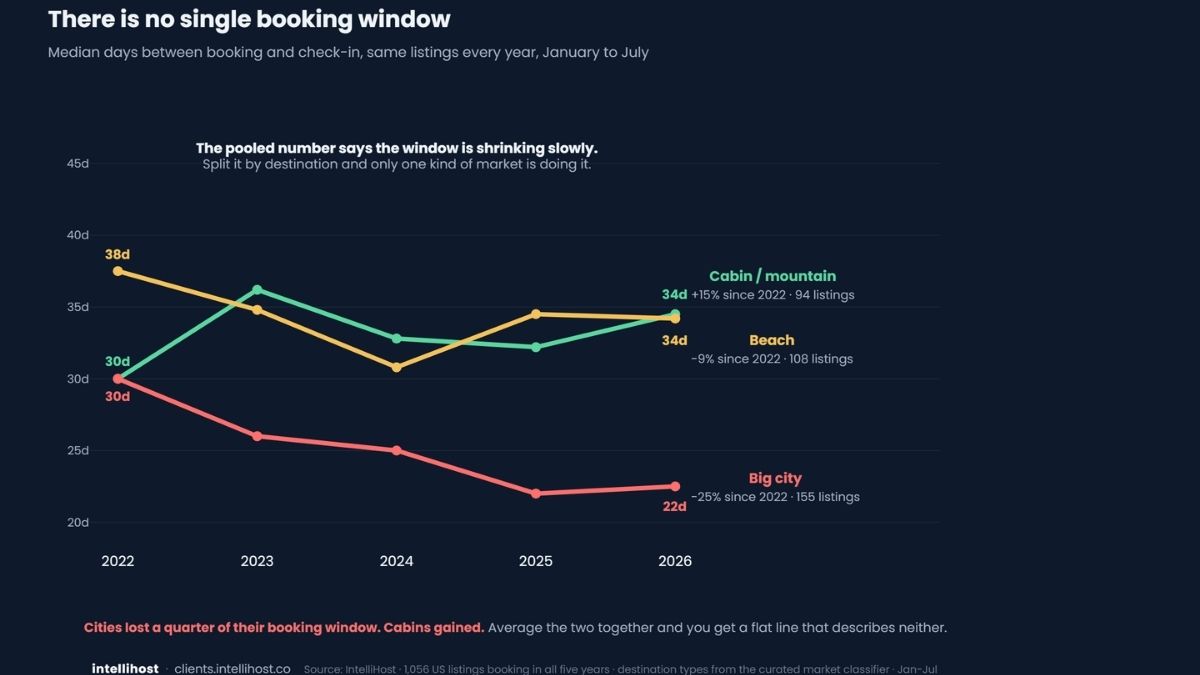
First-page impression rates on Airbnb held between 41% and 45% every month for a year. So listings are getting in front of guests, but what happens after is where bookings are falling apart. Overall search-to-booking conversion sat between 1.2% and 2.4% across the full 12 months. Even in the best month, March 2026 (2.4%), 97 out of every 100 searches didn't end in a stay.
The data points to a different problem than the one most hosts try to solve. Getting found is not the bottleneck. As we've covered before, the pricing-and-visibility framing misses where the actual gap sits. Airbnb is driving traffic. Hosts are competing for the ~2% of that traffic that converts, and the strategies that improve conversion (response speed, listing structure, how easy it is to book) use a different set of tools than the ones that improve visibility.
Demand Is Moving Earlier in the Year
One more pattern worth noting: VRBO search demand for March 2026 surged 74% year-over-year. July dropped 45%. August fell 58%. Expected summer occupancy sits at 56-60%, but actual occupancy is tracking 43-50%. Hosts pricing and planning around historical summer peaks are likely to see a gap between what last year's calendar implied and what this year's bookings deliver.
What This Means for Hosts
Hospitable and IntelliHost sharing data at this scale is genuinely useful for hosts trying to make proactive calendar and pricing decisions. The three patterns in this report cover different parts of the business (impression to booking, listing structure, what happens after the booking is confirmed), and each one is worth a closer look at how it shows up in your own calendar. The data is the value here. What hosts do with it is going to vary listing by listing.

.webp)
.jpg)