As Airbnb and other booking platforms put more weight on guest engagement signals, the quality of a listing’s content is playing a bigger role in determining which listings outperform their local markets.
The PriceLabs Data Science team studied how listing content quality influences performance and search visibility. “In this study, we set out to quantify something many operators suspected but couldn’t prove, that listing content plays a measurable role in performance,” said Pedro Borges, Director of Data Science at PriceLabs. “In many cases, pricing adjustments were logical, but applied too late in the guest journey to have impact.”
The analysis reviewed more than 10,000 active listings across nine global cities. Instead of focusing on price, the team evaluated listings independently of pricing strategy to isolate the impact of the content. The study also controlled for seasonality, demand cycles, market maturity, and city-level pricing differences.
Why Price Changes Often Come Too Late
When bookings slow, pricing is usually the first thing operators adjust. Nightly rates are lowered. Discounts are added. Minimum stays are relaxed. But the study found that many underperforming listings were already priced competitively compared to similar listings in their market.
“As platforms evolve, we’re seeing a clear shift. Visibility is becoming just as important as price,” Borges said.
Put simply, price only matters if guests actually see the listing. Even steep discounts can't fix a visibility problem.
Listings with weak or inconsistent content are shown less often, appear lower in search results, and receive fewer clicks. This creates a compounding effect: Lower visibility leads to fewer impressions → Fewer impressions reduce booking opportunities → Reduced booking activity reinforces weaker ranking signals
This means before asking “Is the price right?” operators first need to ask “Is this listing being seen?”
Core findings
Across all markets analyzed, content quality consistently separated top-performing listings from underperformers.
Key findings include:
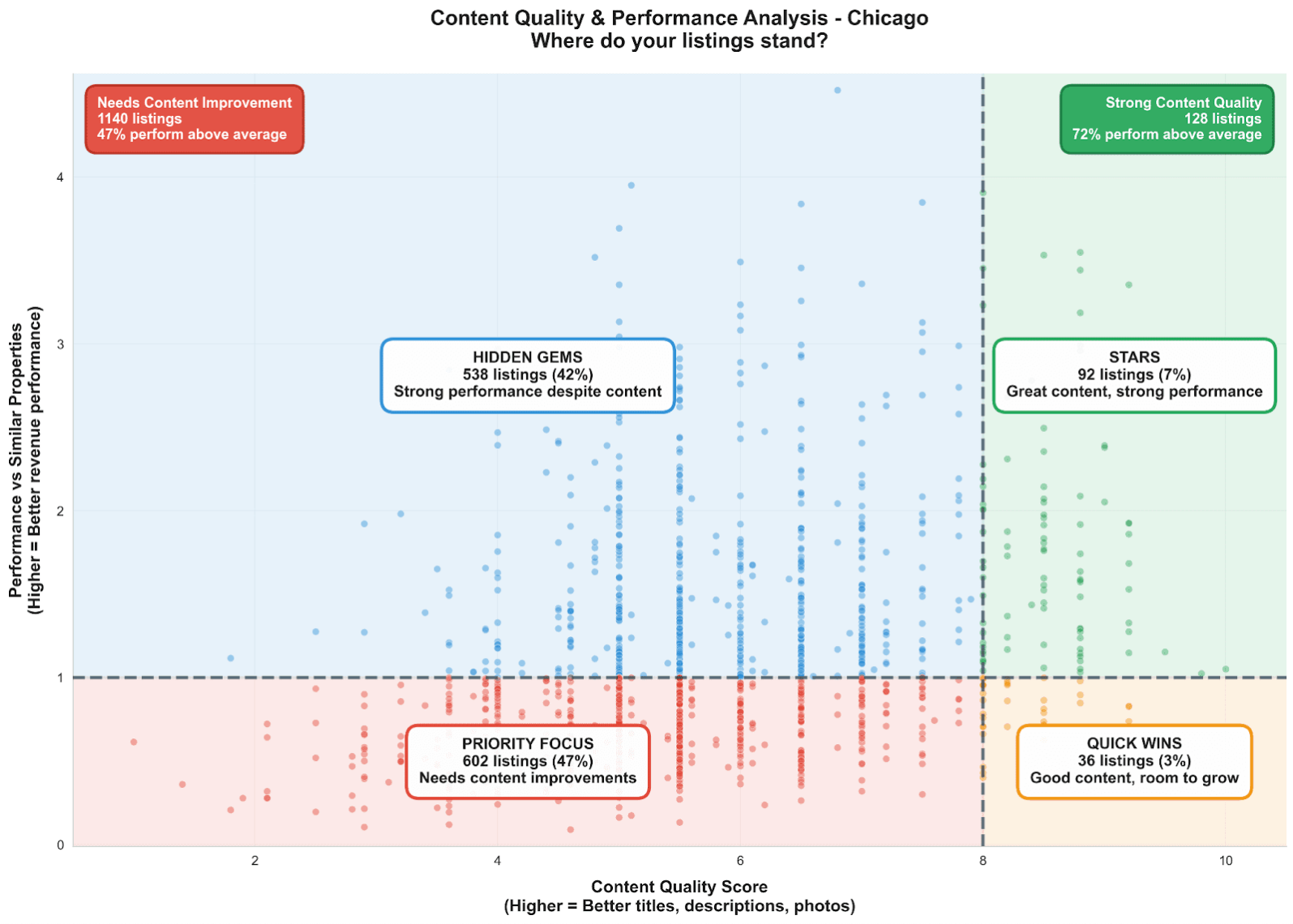
- Only 12% of listings earned high content quality scores, yet these listings were 35% more likely to outperform their local market
- Listings with weak or inconsistent content clustered heavily among underperformers, regardless of pricing strategy
- In Chicago, 72% of high-content-quality listings outperformed comparable peers, reinforcing the link between content quality and relative performance
How content quality influences search visibility
The analysis identified four main ways content quality affects search visibility and booking performance:
- Clarity and completeness: Listings that clearly explain key details reduce guest uncertainty and earn stronger engagement signals.
- Image quality and structure: Poor lighting, missing photos, or weak cover photos reduce click-through rates and early engagement.
- Consistency across content: When photos, descriptions, and amenities do not match, trust drops and page views shorten.
- Guest feedback loops: Repeated review complaints about unclear details or unmet expectations reinforce negative ranking signals over time.
These issues were common across the dataset:
- 70% of listings used low-quality or poorly structured images
- 54% had incomplete or unclear descriptions
- 54% showed mismatches across photos, text, and amenities
The findings show that when content problems reduce visibility, pricing changes fail to drive more bookings, not because the price is wrong, but because guests never see the listing. For hosts, this context helps clarify where time and effort are best spent.
Read the full Pricelabs report here.

.webp)