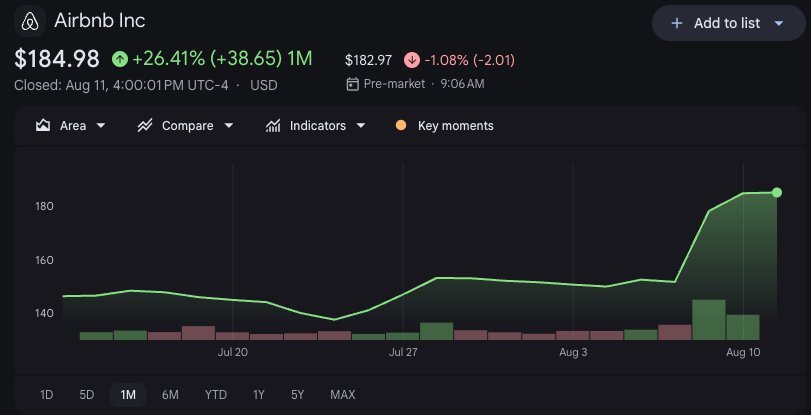
Airbnb crushed Q2.
Revenue grew 17%. Gross booking value grew 16%. Nights and Seats Booked grew 10%.
If you own Airbnb stock, you probably feel pretty good right now.
But as a host, there were two parts of the call that made me sit up a little straighter.
Because here’s the thing: What’s good for Airbnb is usually good for hosts. But not always.
And as Airbnb grows, two new places are showing up where the company's incentives pull away from what's best for hosts.
1. Hotels are crowding the search results
Airbnb’s hotel business is really taking off. It's still small overall, but hotel nights are growing roughly 3x faster than Airbnb’s homes business.
Brian Chesky said the hotel business is "going significantly better than I expected, and I had high expectations."
So Airbnb’s expanding Hotels from its initial rollout in just a few cities (like NYC, where short-term rentals are heavily restricted), into "all markets."
Airbnb’s pitch to hosts is basically: Don’t worry. Hotels make the whole marketplace stronger.
And every Airbnb exec who talks about hotels repeats the same stat: 35% of people who book a hotel on Airbnb for the first time later come back and book a home.
Sounds great, right?
But look closely at what that stat is actually telling us…
Airbnb’s making it seem like hotels are bringing in new people to Airbnb, who then discover your listing in the future.
But they’re really just talking about someone’s first hotel booking on Airbnb. They do not explicitly say those people were brand-new Airbnb users when they made the hotel booking.
That’s a big distinction...
Imagine I’ve booked 20 Airbnb homes over the years. This year I search Airbnb, see a hotel, and book a hotel instead of a home.
I’m now a “first-time hotel guest.”
If I come back six months later and book another home, I look like proof of Airbnb’s 35% statistic.
But in that situation, Airbnb took a booking that would have likely gone to a home and gave it to a hotel. (Let's be honest, people still come to Airbnb thinking "home," not "hotel")
Now, maybe that isn’t what’s happening. Airbnb argues that hotels also convert travelers who otherwise would have left the site entirely. That makes sense, and it could be true.
The problem is: they aren't telling us the stat that actually matters.
The number I want to see is how many hotel bookings represent truly new guests making their first booking on Airbnb.
My hunch? If adding hotels is actually flooding the platform with new users, that's the number Airbnb execs would be bragging about.
Here's what I can say for sure. Every hotel Airbnb adds is one more result competing for the same screen your listing lives on. And there are only so many slots on page 1 of the search results.
That makes owning your guest relationship even more important: distribute your listing across multiple channels, build direct bookings, and stay in touch with past guests… Because the more that Airbnb grows, the harder it's going to be to find your listing.
2. Airbnb’s new pricing algorithm
The second thing that caught my attention was Airbnb’s new AI pricing model.
Chesky called pricing "one of the single biggest levers that we have to accelerate the growth of our core business."
CFO Ellie Mertz was even clearer. Airbnb wants hosts to be “as price-competitive as possible,” and she said: “In many cases, that means we encourage our hosts to bring their prices down.”
To be fair, she also said Airbnb wants to maximize host earnings. And I don’t think Airbnb is actively trying to make hosts earn less.
The issue is simpler:
Airbnb is optimizing a marketplace. You’re optimizing a property.
That's an incentive mismatch that's worth understanding:
- Airbnb earns a fee on every booking, so more bookings at lower prices means more new guests who keep coming back to Airbnb for years.
- Hosts want to maximize the profit generated by their properties. You want the highest nightly rate you can hold without losing occupancy.
I understand that sometimes dropping your nightly rate 10% produces enough extra occupancy to make you more money.
Great.
Other times, you just sold nights cheaper than you needed to.
So Airbnb’s new pricing model may end up being incredibly sophisticated. They say it’ll incorporate Airbnb prices, hotel prices, events, booking lead times, and other data that individual hosts could never replicate themselves.
It could be an interesting data point… but I wouldn't trust it.
The incentives just aren't aligned.
And to me, that’s the larger takeaway from this earnings call:
Airbnb is getting better at optimizing for Airbnb. Hosts need to make sure they’re getting equally good at optimizing their own businesses.
Further reading