Ask around about direct bookings and you will hear the same caution every time. Yes, you save the platform fee, but push it too far and Airbnb notices. Fewer bookings flowing through the platform, the theory goes, and the algorithm quietly drops you down the results.
So operators hedge. They build a direct channel and then hold it back, deliberately leaving money on the table to keep a marketplace happy.
We went looking for that penalty in our own data. It is not there, and the way it disappears is worth understanding, because the first look at the numbers says the opposite.
The first look says the warning is true
We took 2,284 connected US listings where the property management system labels the booking channel on every reservation, and sorted them by how much of their business comes direct. Then we compared them across the Airbnb funnel.
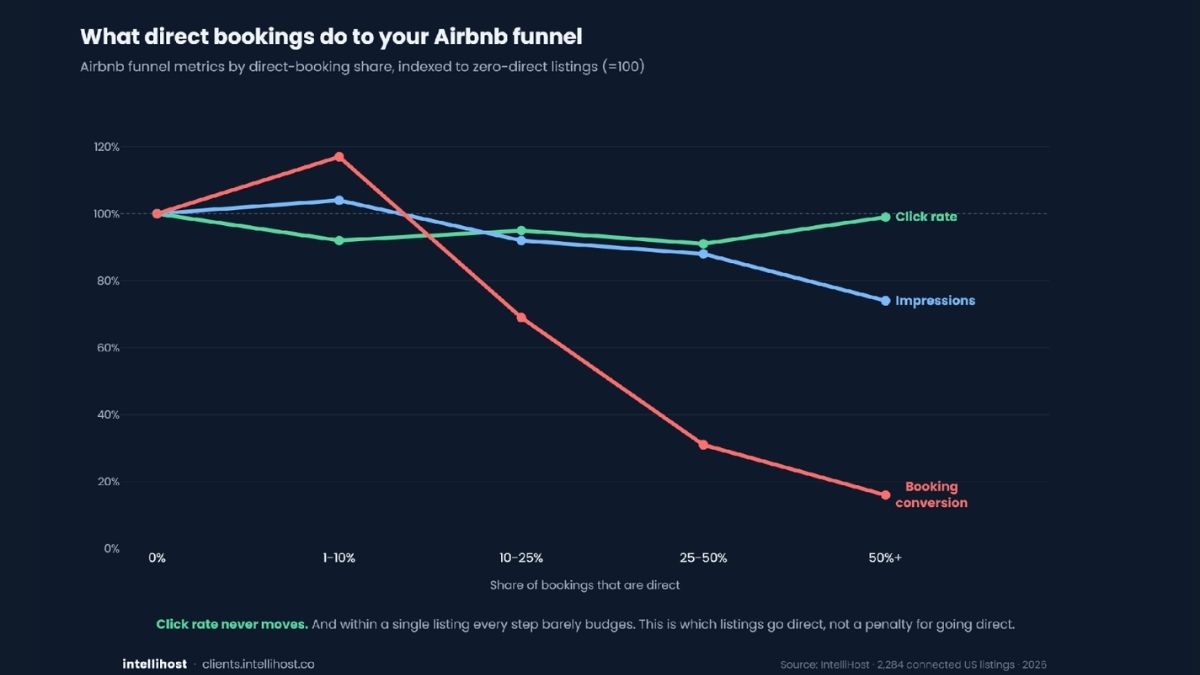
Listings with more than half their bookings direct reach Airbnb’s first page about 26% less often than listings that stay on the platform, and their booking conversion is roughly six times lower.
If you stopped reading there you would tell your owners to keep everything on Airbnb. Plenty of people have stopped reading there.
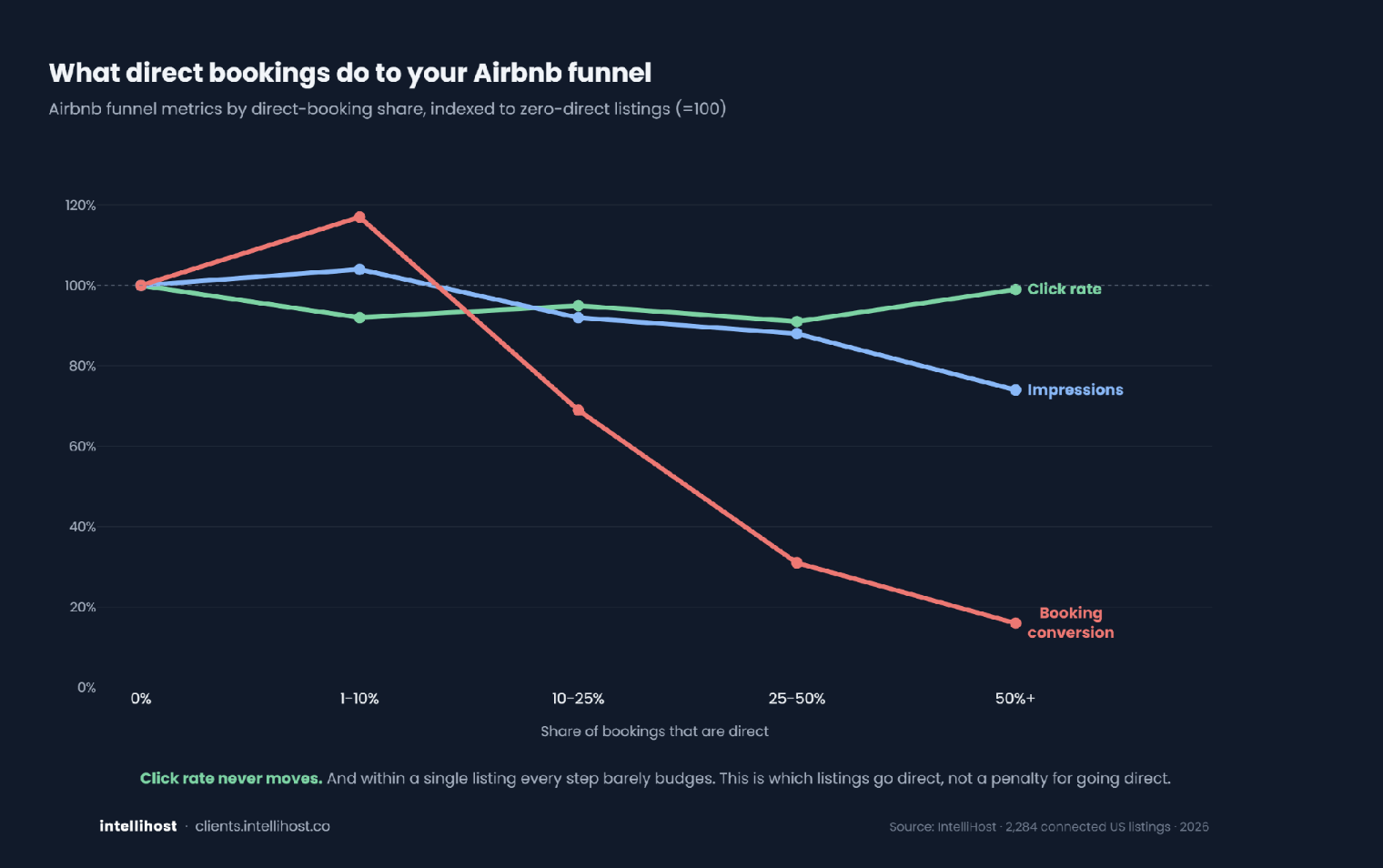
Two things in that table break the story
The first is total volume. If Airbnb were punishing these listings, their direct business would be compensating. It is not. A listing with more than half its bookings direct fills about 86 nights a year. The low-direct listings fill between 158 and 228. These are not thriving operators who shifted channels. They are lower-demand listings, and low demand is frequently the reason a host leaned into direct in the first place. The causation runs backwards from the scary reading.
The second is the click rate column, which does not move at all. From zero direct to more than half, listings get clicked at roughly the same rate, 0.21 to 0.23, whenever they appear in results. If heavy-direct listings were simply worse listings, fewer people would click them. The nightly rate is flat too. Whatever is happening here is not making listings less appealing and it is not costing anyone price.
The test that actually answers the question
Comparing different listings can only ever produce correlation, tangled up with the fact that direct-heavy operators run different properties.
So we ran the test that isolates cause. We followed each listing month by month and asked a within-listing question. When a given listing increased its own direct share, did its own Airbnb funnel weaken in the months that followed, holding its total occupancy constant?
Holding occupancy constant is the important move. A booked night blocks your calendar identically whether it came from Airbnb or from your own site. Once you account for how full a listing is, anything left over is a pure channel effect. If Airbnb punished direct reliance, this is where it would appear.
It does not appear. A 25 percentage point jump in a listing’s own direct share moved its first-page impressions by about 2%, its click rate by about 7%, and its booking conversion by a similarly faint amount. All weak, all roughly equal, none of them the collapse the cross-section implied.
The 26% gap and the six times lower conversion dissolve the moment each listing is measured against itself. They were selection the whole time.
An objection worth answering
When I published a version of this, a business development lead at a major hospitality brand raised the sharpest challenge I got. As operators push direct, their availability itself changes, which changes their opportunity to appear, convert and earn reviews on Airbnb.
That is exactly right, and it is why the metric here is the first-page impression rate rather than impression volume. Raw impressions do fall as you move dates off Airbnb, because a night you have already sold cannot be shown for those dates. That is inventory moving where you sent it. The rate is an efficiency measure and it does not care how much calendar you have left.
The honest limits
This is observational data, not a controlled experiment. The within-listing test is the strongest evidence here, but only around 190 listings had enough month-to-month movement in their direct share to power it, across 2,268 property-months. That means we can rule out a large penalty with confidence and a very small one less so.
The analysis only covers listings whose property management system labels the booking channel, so it describes professionally managed inventory rather than the whole platform.
What to do with it
If you have been throttling your direct channel to protect an Airbnb ranking, you can stop. The visibility tax everyone warns about does not show up at any step of the funnel, and your Airbnb nightly rate is untouched.
The only real cost of a direct booking is the obvious one. It is a night Airbnb can no longer sell for you. That was the entire point of taking it direct.
IntelliHost gives short-term rental operators the search and booking data behind their listings, including how often they appear in Airbnb search and where bookings are lost. You can see what it looks like for your own portfolio at intellihost.co.

.webp)