Beyond’s new global industry report, A Look Beyond, draws on data from more than 750 million listings and shows how guest behavior, market performance, and regulation shaped the STR sector in 2025. The year closed with tighter booking windows, longer stays, stronger occupancy, and new trends to consider as operators plan for 2026.
2025 Performance
Regulation and Macro Disruptions Reshaped Early-Year Demand
In the U.S., Tariffs and political uncertainty during the first quarter disrupted cross-border demand, and searches from Canadian travelers for U.S. stays fell 50% in March and April compared with 2024. The decline highlighted how sensitive international travel became to macro conditions, even as domestic searches held steady.
In Europe, travel patterns moved for different reasons. Regulation consistently tightened across Europe throughout 2025. Cities adopted stricter licensing systems, new occupancy caps, and more detailed compliance checks, which slowed supply growth and increased operating costs. These friction points created a meaningful shift in how inventory entered the market, even as demand stayed resilient.
Occupancy Became the Primary Growth Driver
Across major regions, occupancy gains powered revenue performance. Markets that captured more nights before adjusting rates saw the most stable year-over-year results.
United States
The U.S. led all major regions with 53.1% occupancy, a 3% lift year over year. ADR rose 2% to $248.71, producing a 1.2% increase in revenue per available night (RevPAN).
Europe
Europe posted the strongest occupancy momentum of any region, climbing 9.1% to reach 50%. ADR was effectively flat at +0.1%, but fuller calendars drove RevPAN up 7.3% despite regulatory headwinds.
Australia
Australia posted 52.3% occupancy for the year, a 6.5% lift over 2024, while ADR fell 3.4% to $187.74, resulting in a 1.7% RevPAN increase.
Across all regions, listings with live market visibility outperformed static settings. Beyond reports substantial outperformance for operators using real-time insights for their revenue management.
Shorter Lead Times, Longer Stays
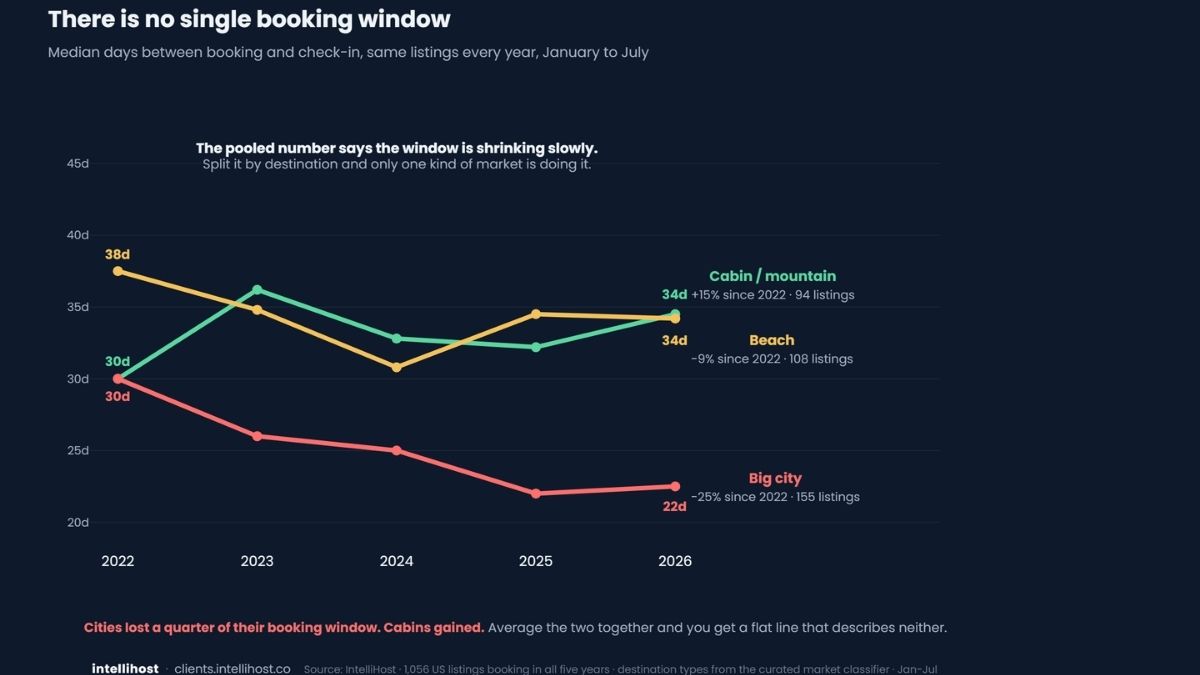
Guest behavior stayed consistent across markets. Travelers booked closer to check-in, but once they committed, they stayed as long or longer than the year before.
Average lengths of stay rose across all regions:
- United States: 5.7 nights
- Australia: 6.0 nights
- Europe: 6.6 nights
Lead times fell in the United States (26.8 days) and Australia (22 days), while Europe moved slightly longer to 35.1 days. The combination of later bookings and steady stay lengths signaled growing consumer confidence in same-week and last-minute availability.
Heading Into 2026
Search Trends Show Sharp Differences Between Domestic and International Demand
Beyond analyzed search activity from more than 800 direct booking sites to understand early demand formation for 2026.
In the United States, 95% of searches for U.S. listings came from domestic travelers. Australia and the United Kingdom showed a similar pattern, with more than 94% of search volume originating locally.
Most of Europe moved in the opposite direction. In France, only 27% of searches were domestic, with Spain and Italy showing similar levels of international search weighting.
Beyond also compared searched lengths of stay with booked stays for January through March 2026. In the United States, searched and booked stays matched closely. In the UK, travelers consistently searched for longer stays than they booked, revealing a gap between early exploration and final commitments.
3 Themes for 2026
Three macro themes stand out as we head into 2026:
#1 Search intent is becoming the earliest and most reliable signal of demand.
#2 Booking windows are compressing as guests rely on late availability.
#3 AI is moving into a co-pilot role. “AI will raise, not replace, the human role,” said Gerard Murphy, VP of Product at Beyond, noting that the technology is taking on complexity while operators focus on strategy and relationships.

.webp)