When a city caps short-term rentals at a fixed number of nights per year, most of the debate that follows is about housing. For the people running those properties, the more pressing question is commercial: what happens to your revenue when you can no longer sell every night there is demand?
Salt Lake City gives us a rare way to answer that with data. Since July 1, every licensed short-term rental in the city has operated under a new framework: a 200-night annual rental limit, a two-night minimum stay, individual business licensing, and limits on how many rentals can run inside a single residential building. Using listing-level 2025 data for the Greater Salt Lake City market, KeyData modeled how that 200-night cap would have affected year-round rentals based on how they actually performed last year¹. The aim was to understand how a fixed annual limit changes the economics of operating a rental, and what operators should do about it.
A cap changes what you optimize
Revenue managers have two levers: sell more nights, or sell nights for more. A 200-night cap removes the first once you hit the limit. A property capped at 200 nights tops out at 54.8% annual paid occupancy (200 of 365 nights). As a property approaches the cap, each remaining permitted rental night becomes more valuable. Pricing carries the growth from there.
Nearly half of the year-round listings would have hit the limit
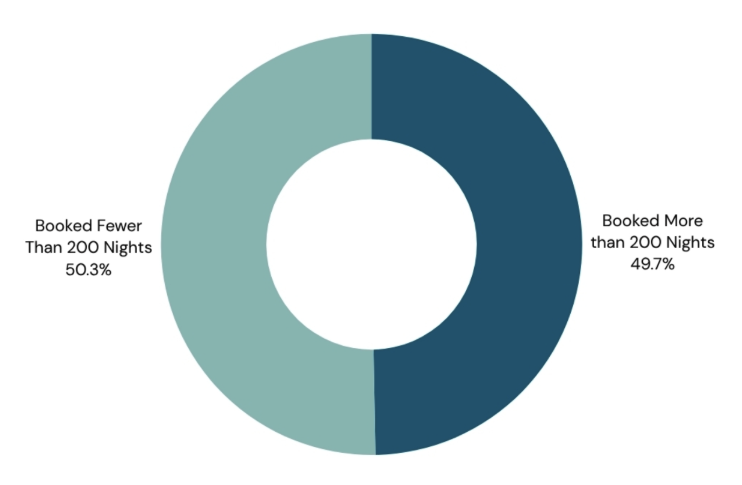
We looked at entire-home listings available for at least 330 days in 2025 to isolate established rentals rather than seasonal or part-year ones. That cohort held 3,144 listings. Of those, 1,563 (49.7%) booked more than 200 nights last year, and 1,581 (50.3%) stayed below it. So close to half of the consistently active rentals in this market would have run out of permitted nights before year-end, despite having booked additional nights beyond the threshold in 2025.
The revenue at stake, and the RevPAR problem underneath it
For listings that exceeded 200 nights, we modeled the revenue from nights above the limit using each property's realized 2025 ADR. The median affected listing booked 43 nights past the cap, worth around $7,300 (the average was closer to $9,100). As a share of annual revenue potential, that is a median reduction of about 18%.
Read those as revenue currently earned beyond night 200, not as forecast losses. Property managers would adapt in practice, moving the rate up in peak periods and steering their limited nights toward stronger demand.
The harder problem lies in RevPAR. Because the cap limits occupancy, it limits the RevPAR a property can generate at its existing ADR.
For listings over the threshold, the modeled cap cut median calendar RevPAR by about 20% with ADR held flat. To hold the same annual revenue under the cap, the median affected listing would need to lift ADR by roughly 23.5%. Growing revenue through volume stops being an option, so it has to come from rate.
The most exposed properties are the smallest ones
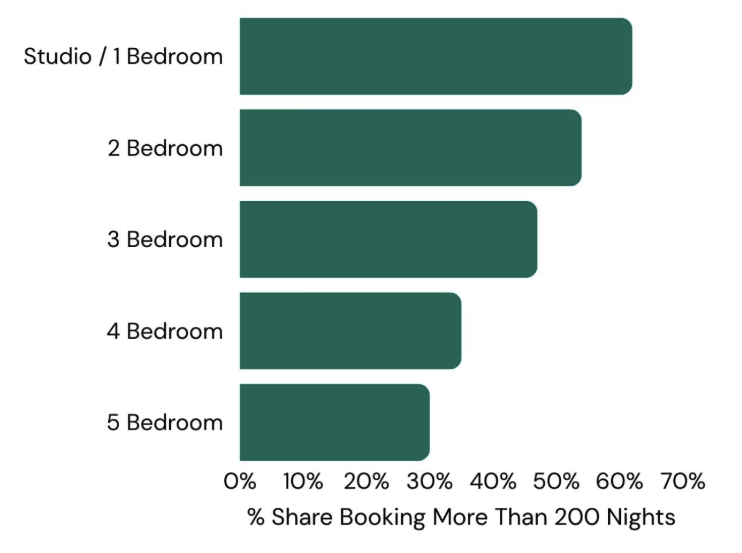
The finding I would put in front of any property manager: the listings most likely to hit the cap were the smaller ones, well ahead of the large luxury homes. In our data, 62% of studio and one-bedroom listings booked more than 200 nights, compared with 30% of five-bedroom listings.
The driver is demand, not price. Smaller homes attract a broader mix of travelers throughout the year, including business travelers, university visitors, relocations, and shorter leisure stays. Larger homes often have higher ADRs but depend on seasonal peaks, leaving more nights empty off-season. The properties most likely to reach the cap are the ones that stay busiest year-round.
How to run a property under a fixed ceiling
When occupancy is capped, pricing does the work and every permitted night is worth defending. If you operate under an annual limit, a few priorities move to the top:
- Reserve nights for your highest-value demand: peak weekends, holidays, and major local events
- Hold the rate through strong demand rather than discounting to fill
- Evaluate owner blocks strategically, particularly when they overlap with high-value demand periods
- Watch booking pace against market benchmarks to see which nights are worth taking
The job shifts from filling the calendar to deciding what earns a place on it. That is a strategic call best made at the start of the year rather than a rate tweak revisited week to week.
What this means past Salt Lake City
Salt Lake City is one of several US markets tightening short-term rental rules, and the same conversations are now moving through other cities. Whatever the next ordinance targets, whether annual nights, licensing, density, or zoning, regulation changes market performance in ways you can measure. The operators who come out ahead will be the ones who read those trade-offs before the rules reach their own market and set pricing strategy on their own terms, while there is still time to shape the outcome.
Methodology:
¹This analysis uses listing-level market data from calendar year 2025 for the Greater Salt Lake City market. It includes entire-home listings that are active on booking platforms for at least 330 days during the year and have at least one booked night. Revenue above the cap was modeled using each listing's realized 2025 ADR, illustrating how 2025 performance would have looked under a 200-night annual limit. Because the ordinance applies within Salt Lake City municipal limits, results should be read as a market-based scenario analysis rather than a direct estimate of the ordinance's impact on licensed properties inside the city.

.webp)