Major Market Shifts in 2025
The year opened with volatility across travel. Trade wars and new tariffs slowed inbound demand to the United States, and international traveler’s search behavior shifted fast. For example, Beyond pricing found that during March and April, searches from Canadian travelers for U.S. stays dropped 50% compared with 2024. Domestic travel demand held steady, but the gap highlighted how sensitive international flows can be.
Policy changes created equally significant shifts. U.S. lawmakers restored 100 percent bonus depreciation, incentivising more high-income earners to consider short-term rentals as both an investment and a tax strategy. In practice, the rule allows any paper losses from depreciation to offset active income, which includes W-2 wages and business income. The financial impact for high earners was immediate. STRs reclaimed their position as a preferred vehicle for sheltering income while building an asset base.
Monetary policy also began to ease. As the Federal Reserve started cutting rates, mortgage rates inched down. The shift came slowly, but it was enough for investors to resume underwriting deals.
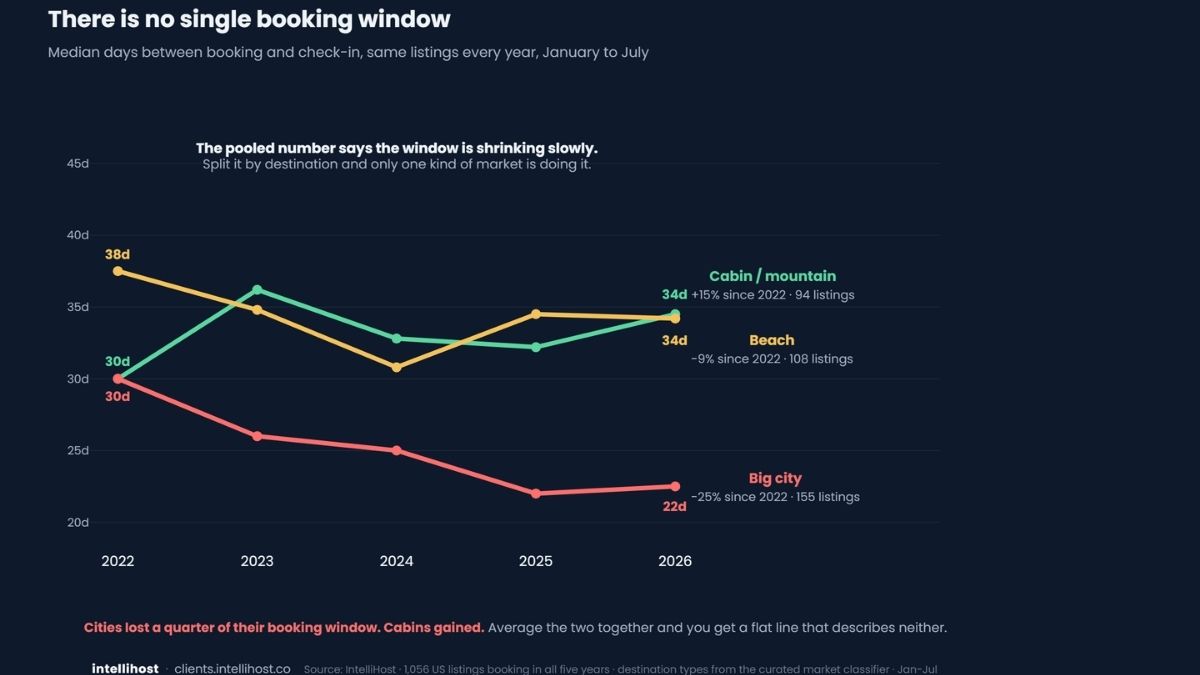
Booking behavior changed more than any other factor. Direct bookings surged as hosts looked for better margins and guests pushed to save fees. High-income travelers continued booking at similar rates, but the average guest waited longer to commit. Shorter booking windows became normal across Airbnb, Vrbo, and nearly every other booking platform.
Taken together, the market shifts in 2025 forced operators to adapt pricing, acquisition strategy, and channel mix in real time.
Airbnb’s Platform Changes
It feels like Airbnb changed more in the last year than it had in the prior five. The platform restructured quality standards, rewrote communication rules, launched new business lines, rewired the booking flow, and reset fee structures. Every host felt the impact.
February: Airbnb Removes 400,000 Low Quality Listings
The company announced that more than 400,000 listings worldwide were removed as part of a quality upgrade.
April: A Completely Overhauled Communication Policy
The April Off-Platform Policy update produced the most operational disruption for hosts.
Key changes included:
- Hosts cannot request guest emails, phone numbers, or any contact information before or after booking.
- All fees must be included in Airbnb’s pricing fields or built into the nightly rate.
- Any upsells tied to the reservation, such as pool heat or parking, must run through Airbnb’s checkout flow.
- Hosts cannot ask for reviews or surveys outside of Airbnb.
- Airbnb’s AI scans all communications for contact details, external links, off-platform payment language, and even basic attempts to direct traffic elsewhere.
- Hosts must offer property access without requiring guests to download third-party apps.
These rules forced immediate changes to check-in workflows, access systems, pricing setups, upsell processes, and feedback collection. It was a full rework of host operations.
May: Airbnb’s 2025 Summer Release
The summer release introduced the most visible product overhaul.
- A completely redesigned Airbnb app. Homes, Services, and Experiences were unified into a single interface. The Explore tab became the primary discovery tool. Messaging added photo and video sharing. Host tools were streamlined for listing creation, reservation management, and calendar control.
- Airbnb Services. Ten categories of in-home services launched in more than 100 cities. Chefs, massage, personal training, spa services, makeup, hair, nails, photography, prepared meals, and catering. Guests can now book providers to come to their rental or to their primary residence. This pushed Airbnb deeper into the concierge and experience economy.
- Airbnb Experiences, rebuilt. Integrated directly into the booking flow and expanded into 650 cities. Social features allow guests to connect before, during, and after an event. Categories include museums, food experiences, outdoor activities, art workshops, and wellness offerings.
July: Cancellation and Payment Changes
Airbnb eliminated “strict” host-side cancellation policies. At the same time, it rolled out two new guest payment structures.
- Reserve Now, Pay Later delays full payment until just before check-in.
- Buy Now, Pay Later introduces installment loans through partners like Klarna.
Both features increased guest flexibility and influenced booking windows.
August: Host-Only Fee Structure
The full fee burden shifted to hosts. This pushed operators to re-evaluate pricing and margins, but it's not as simple as just raising prices. Airbnb's own documentation says their algorithm favors lower-priced listings in search results. So hosts who raise rates to offset the higher fee risk dropping in visibility and losing bookings.
September: Hotels on Airbnb
Airbnb officially opened the platform to hotel listings, signaling a long-term strategy to compete across the broader accommodation market.
Winners and Losers in Property Management
The biggest stories of the year came from property management consolidation. Casago’s acquisition of Vacasa for $130 million transferred roughly 38,000 homes and closed the chapter on Vacasa, a company that had raised more than $630 million and gone public at a $4.5 billion valuation before collapsing.
The deal was a clear signal that the centralized operating model failed. We learned that pricing decisions, maintenance coordination, communication standards, and quality control for 30k+ homes can't all be routed back to a corporate office. What looked efficient on a slide deck couldn't compete with the reality of thousands of hyper-local operational decisions required every day. It was an expensive lesson for Vacasa shareholders.
Casago offered the opposite thesis. Local operators, each responsible for their own P&L, supported by national systems. Their franchise approach is a formula that’s proven to be more sustainable in fragmented industries like STRs to build a strong national presence. It was a huge swing for Casago, as they took over a competitor with nearly 8x as many homes under management.
Several other well-known operators struggled. Sonder collapsed into bankruptcy after repeated attempts to stabilize cash flow. Roami filed for bankruptcy. And Homelike shut down after a decade in business.
New Tech and Major Funding Rounds
AI grew from an emerging trend to basic infrastructure for STRs. Nearly every PMS, revenue management system, and guest operations platform launched AI-driven tools. Guest messaging automation and revenue optimization were the two most common use cases.
The sector also saw consistent venture funding.
The standout was Hostaway’s $365 million private equity round, pushing the company to a $1 billion valuation - the first STR PMS unicorn.
Other notable raises included:
- Gathern, $72 million
- Wander, $50 million
- Holidu, €46 million
- Kasa, $40 million
- Arbio, $36 million
- Steadily, $30 million Series C
- Apaleo, €20 million Series B
- Boom, $12.7 million
- Conduit, $3.1 million dollar seed
- SuiteOp, $3 million dollar seed
2025 wasn't an easy year to be a host. But by the end of the year, operators were more adaptive, more tech-enabled, and more focused on profitability than ever before.

.webp)
.jpg)