I came across a super interesting case study this week that I had to share. Here’s the basic situation:
Let’s say you manage a 30-property luxury portfolio doing $4.5 million in annual revenue.
A new guest books one of your properties through Airbnb. That guest has a fantastic experience, decides they want to make it an annual trip, and because they loved your property so much, they want to stay at your place every time.
So one year later, when the guest is booking your property for the second time, does the guest go back to Airbnb to book… or do they book directly through your website?
It’s a super important question because if the guest goes back to Airbnb to book, Airbnb’s going to charge their full 15.5% host-only fee. Whereas if they book directly with you, you don’t pay that fee and it’s much more profitable. Keep in mind that this isn’t some random guest, it’s a guest you already have a relationship with, and you know is high-quality because they’ve stayed with you before.
Paying that unnecessary second fee to an OTA is called “repeat guest leakage” and the question is: how much money is that costing hosts each year? And what can hosts do about it?
I just found this case study by hostAI where they analyzed over 230,000 bookings across 115 vacation rental operators in 2025 to answer that exact question.
Here’s what they found:
The data shows that:
Repeat guests represent a meaningful share of revenue for vacation rental operators: typically between 5-8%, but all the way up to 26% for some hosts.
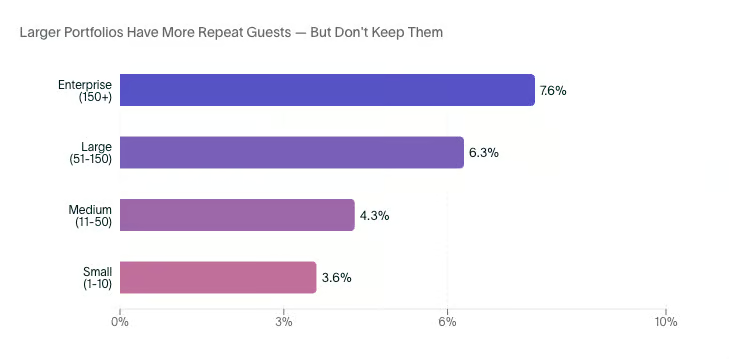
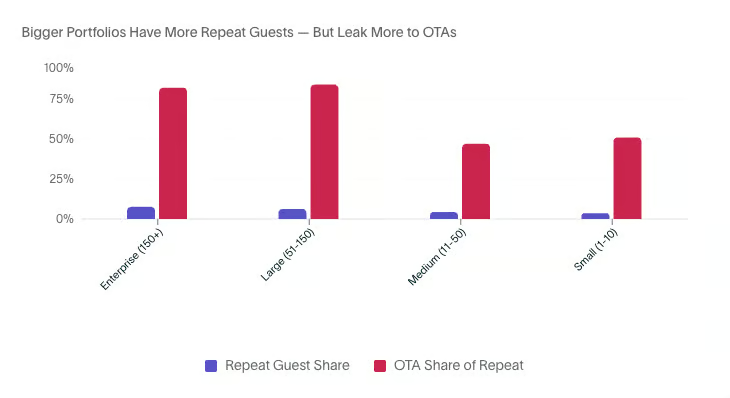
Roughly three-quarters of that revenue (77%) flows through OTAs. That means hosts are paying OTA commissions a second time on guests they’ve already acquired.

As operators scale, repeat guest leakage increases. Larger operators tend to have more repeat guests in absolute terms, but they also leak a higher percentage to OTAs than smaller operators.
Here's what hosts can do about it:
Case Study: 15% Direct Mix Captures 84% of Repeat Revenue
They showed a really interesting case study of one luxury brand in Florida with 30+ listings to illustrate the pattern.
The brand’s direct booking channel represents just 15% of total bookings, but captures 84% of repeat guest revenue. That means one in four direct bookings is a repeat guest, compared to one in sixty-seven on Airbnb.
Two factors appear to contribute to the success:
- Systems to stay in touch with guests. Email campaigns keep the brand top of mind with past guests so that when guests plan their next trip, the brand is already in their inbox.
- Investment into marketing. They invest in Google Ads to drive direct bookings.
The 15% rule
Here’s the real takeaway, I’m calling it the 15% rule: By having the basic systems in place to capture just 15% of total bookings directly, that same infrastructure allows you to capture 84% of the repeat guest bookings.
Let’s use specific numbers to break down what that means. For a 30-property luxury portfolio doing $4.5 million in annual revenue:
- If 8% of guests are repeat guests, that’s $360k in total repeat guest revenue.
- That means capturing 84% of that revenue directly (instead of paying Airbnb’s 15.5% fee) generates an extra $46k in revenue per year that you would have otherwise paid in OTA fees.
That’s substantial. And the part I like best is that setting a goal to get 15% direct bookings feels really achievable. It’s not like you have to try and get 50% direct bookings to stop the leakage. 15% is possible by just executing on the basics: investing in direct booking infrastructure, brand-building throughout the guest journey, and post-stay guest emails.
Just like anything in life, having a direct booking funnel in place doesn’t mean you’re going to get a massive spike in bookings day one. But creating and maintaining those systems can really add a lot of repeat booking value to your bottom line over the long term.